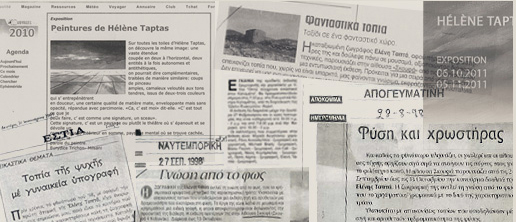
- Landscapes of absence and reminiscence
- by EVRIDIKI TRICHON-MILSANI
- Helene Taptas told me:
- by EVRIDIKI TRICHON-MILSANI
-
Landscapes of the soul signed by a woman
- by KRISTA CONSTANTINIDI
- Citizen Painters - Helene Taptas
- by ELDER METROPOLITAN OF CHALCEDON ATHANASIOS
- This is not a landscape
- by EVRIDIKI TRICHON-MILSANI
- Interview (excerpt)
- JEAN - MARIE DEDEYAN
-
Three new themes in the work of Helene Taptas
- EVRIDIKI TRICHON-MILSANI
-
Newspapers / Magazines / Art Books / Websites
Landscapes of absence and reminiscence
by EVRIDIKI TRICHON-MILSANI
Landscapes have claimed their own place in painting and became an
area for experimentation, abstraction and meditation. The
incredible variety of nature and natural phenomena, the seasonal
transformations and changes of light offered to artists the
ability to free themselves from the academic treatment of the
human form and from realistic representation. However, either
because it was overused in photography, or because after pop art
the interest of artists focused on urban landscapes, or because we
are living in increasingly larger, suffocating cities, the
depiction of nature has been removed from the novelty list.
Landscape artists - we once called them outdoor artists - are rare
nowadays; that is why the work of Helene Taptas, which comprises
landscape paintings exclusively, is arresting and startling.
Usually, when we talk about landscapes, we automatically think of
nature. A glance at the artist’s landscapes is enough to make us
understand that what characterizes her work is not so much nature
as a disposition to go beyond naturalness. Neither imaginary nor
particularly bizarre, her work is sufficiently vague and does not
oblige the spectator to recognize something real.
On the verge of abstraction, bare, without anecdote or other
narrative element on which to build a story, these empty
landscapes, densely painted, are images between the conscious and
subconscious. Their inner movement is not related to impressionism
or to instantaneous snapshot imagery. On the contrary, each has a
metaphysical duration and symbolism.
Within, always predominant is the line of the horizon with its
nuanced symbolism. It cuts the painting into two components, earth
and the sky. The strip corresponding to earth is often thinner
than the one that corresponds to the sky. The earth element is
worked with motion, thin decisive interventions that create forms
on the brink of abstraction. In the upper part the eye does not
stop on the slopes and mountain peaks but enjoys the spaciousness
of the horizon, at times clear and translucent, at others
scattered with clouds. The sky element is the core of the
painting. Clear skies, cloudy skies, threatening, wet, dry or on
fire, they lend themselves to a reading of the omens and cultivate
the need to escape. Through the silence ensured by the absence of
any living being, the discreet vibration of color introduces a
restrained lyricism.
Sometimes a grey or ochre smoke brings to mind the horizons of
Yves Tanguy, which capture the eye and immobilize the thought with
their magical, extraterrestrial allure. Here, on the contrary,
there is a reserve of truth and calm, while thinking remains
alert. Viewers abandon themselves to the journey of horizons and
reminiscence.
It is obvious that what interests the artist is to compose her own
landscape: through a personal environment, under a light that is
somewhere between dusk and dawn, she wishes to reveal an inviolate
land, ideally solitary that no vulgar tourism could ambush.
In such a spare context, the presence of even the smallest tree or
building is dramatized and assumes a symbolic character. Taptas
does not place any emphasis on such dramatization. She does not
wish to impress. However, her reserved intensity moves us. It is
like the explosion of a scream in its soft musicality.
These landscapes accompany and absorb our thoughts with their
silent harmony. They act like the pages of a very personal diary,
which we are called on to read. Their indeterminate melancholy,
the awareness of an absence, don’t depress us so much as free us.
Helene Taptas told me:
by EVRIDIKI TRICHON-MILSANI
“My landscapes are internal landscapes. I have approached them in
various ways: collage, drawings, oil. They are always the same.
When I was a graphic artist in Paris, when I decorated walls and
screens, the same images would come to me always. A nature that
expresses my feelings. Perhaps, they are a personal defense for
me.
I was born in Istanbul, lived in France and then in Greece. The
journey was always experienced as a constant detachment. Countries
with their impressions and emotions seemed like landscapes viewed
from behind the window of a train or a porthole. Perhaps that is
why my stance in relation to the landscape is distant: I deal with
it from a distance.
When I returned to Greece from Paris, I decided to study under
Thanasis Stefopoulos. He is a serious, solemn person who matches
my inner backdrop.
Since then, getting on for twenty years now, I have been
exclusively dedicated to painting.
When I start a painting, I am motivated by a need for color that
is determined by my frame of mind.
I am never close to my landscapes. They are dictated through
nostalgia, solitude and dream.
I like skies a lot for their vivacity, sudden light, silence,
subtlety.
I like rocky places. I like dusk, twilight, shadows. However, I
have never used a real landscape as a model. When confronted with
nature I browse, suck it in. Sometimes I make a quick sketch to
hold on to an atmosphere. Still, I always work locked up in my
studio recalling the feeling that the natural landscape has left
in me.
I am influenced by Skiathos where I spend my summer holidays. It
has tremendous skies and its spectacular storms change the
landscape constantly. I like the grey of the island: the petrified
sea.
The subject is another important element. That determines the size
and form of the image. There are subjects that I envision in a
specific size immediately. A small painting may be easier to
create but does not express less than a large one.
I work with oil, sometimes with charcoal - media that have the
transparency I need. I also like pencil.
Even though my landscapes are extremely abstractive, they remain
landscapes: I need representation. I need a specific structure, a
construction, so that I can control it.
I remain somewhere between dream and reality: a mixture of these
two with the elation which color gives me. Color that is as
sensitive and harmonious as possible.
I do not always sign my paintings because I often do not consider
them finished. Since they do not reflect a specific reality,
something definite, they do not exclude constant labor to reach an
indisputable balance. It is like the dancers who seem to float
onto the stage, and seem rested; you can’t tell how much work has
gone into it.”.
Landscapes of the soul signed by a woman
KRISTA CONSTANTINIDI
Years ago, in the fall of 98, on the occasion of Helene Taptas’
first solo exhibition, I had wondered in my notes about the
criterion that convinces us to characterize her painting as being
good. Beyond any trends, fashion or gimmicks. In the end, I
concluded it was the magnitude of honesty that was hidden behind
this artwork. Even though at some points it betrayed the
awkwardness of exploration.
Today, six years later, watching the progress of her new work, one
can see more clearly this additional dose of honesty included in
the artist’s dealing with her object. Meaning a dedication that
does not leave any margin for deception of the viewer. Taptas'
landscapes, oil on canvas, small or large have brought us once
again close to the authentic feel of the elements of good
heartfelt painting which follows the dictates of art but also
listens to the soul.
The difference is that in her recent work, her script is
recognizable, it has acquired an identity. Her compositions are
typically divided in two units, the earth and the sky. Or
otherwise, a strong, almost expressionistic gesture in contrast
with the elusive grey-blue hues. And among them, tiny lonely
forms/buildings bring balance to this antithesis by dramatically
suggesting a human presence which is for the rest completely
absent.
The exquisite landscapes of Taptas (I liked the correlation with
the outdoor artists in the catalogue article), lead her steadily
and effortlessly to conquering her art.
Citizen Painters - Helene Taptas (excerpt)
by ELDER METROPOLITAN OF CHALCEDON ATHANASIOS
H. Taptas impresses us with her unadorned, fine, Doric, dreamy and
moonlike landscapes from which man is exiled as from the cities of
B. Buffet, but nevertheless so palpable and expressive, like her
fruits and flowers, with some remnants of nature - trees, plants
or traces of man, rudimentary houses. Inner landscapes where the
cloudy sky and the calm of the ‘petrified’ sea (per H. Taptas) are
contrasted; where light plays an important apollonian role but the
Faustian roar of the North is not missing; where at times an
asceptism of color prevails, while at others it is a sweet,
discreet polychromy, a velvety softness of the brush and also a
pasty, free, palette.
Her work has received excellent critical acclaims in the Parisian
magazines Point and Crée. Thus, E. Trichon-Milsani notes: “bare,
without anecdote or other narrative element on which to build a
story, these empty landscapes, densely painted, are images between
the conscious and subconscious... Sometimes a grey or ochre smoke
brings to mind the horizons of Yves Tanguy, which capture the eye
and immobilize the thought with their magical, extraterrestrial
allure. Their indeterminate melancholy, the awareness of an
absence, don’t depress us so much as free us”.
This is not a landscape
by EVRIDIKI TRICHON-MILSANI
We discover the same image in all Helene Taptas’ paintings: a huge
expanse divided horizontally, two elements at once independent and
contradictory, complementary one could say, that are dealt with in
the same manner: large brushstrokes, velvety hues in soft tones
stemming from two or three colors softly intermingled, the quality
of a matt material that covers without being opaque, spread
sparingly. “This is who I am” says the artist. “It is the only
thing I can do, it is like a signature, a seal”. This signature is
a landscape or rather the scenery where a heart is revealed and
blooms. An inner landscape with a few words, a landscape of the
soul where the trapped word of the artist is hiding.
Observing these images, we are surprised to discover that one can
make do with seemingly simple principles. The endless variations
on line, the richness of color shadings, the delicate treatment of
color which, without imposing itself, changes and emits soft,
light feeling. A melancholic anticipation emerges from the always
distant horizon, which over time becomes familiar and encourages
our own reverie.
“For many years I have only been painting landscapes but do not
consider myself a landscape artist” says the artist.
“They are not real landscapes. I am not interested in nature
itself or in what we find in it. A rock, a tree and other natural
elements that one can see in my paintings acquire a symbolic
importance immediately. I can only use them as metaphors. The
reason why I always make this type of paintings is because they
allow me to project my own frame of mind through them, to bury my
feelings. This situation remained static for a long time. But
there came a moment when I felt very lonely in my landscape and
felt the need for a presence. Surprised, I started introducing
things that I could not even imagine before: a house for example.
A house in a landscape is like a story...
“And thus, the human element came timidly into my painting: a
small person dragging a cloud that runs along the line of the
horizon. This could have a surrealistic overtone, but I cannot
insist on this fact. It is like a dream, like the smallest vision.
At other times a person holds a balloon, perhaps alluding to a
childhood age forever gone. I was always charmed by these
characters who with a dreamy look pull balloons along as if they
are big, colorful bouquets...
“The first thing I do when I start a painting is make the line of
the horizon; this is of utmost importance, it reassures me. This
is where the dialogue begins between earth and sky. Sometimes the
one prevails, sometimes the other. A landscape that I had
originally made flat and distant has now acquired a dynamic
perspective that penetrates space. Is it the reality of the house
that necessitated this change?
“Frequently, it is color that guides me and it is impossible to
predict where it will take me. I begin in bluish tones and
everything points to a seascape, and yet I end up painting a wheat
field. In order to avoid the cacophony of contrasts I only use
three colors each time: blue, sepia, black/white, ochre, Naples
yellow, red: color ranges that fit my mood, colors suited to the
particularity of my landscape...” this metaphysical landscape of
Helene Taptas that never ceases to repeat itself and returns to us
in renewed, fine and arresting transformations; that steady
horizon with the setting sun reminding us of the fleeting time
close to dusk, before or after a storm; which, despite a style
which is so discreet, asserts itself and marks a pause in the
chaos of our daily routine. Simple and mysterious it reveals the
hidden temperament of its creator, whose moods come to us as
variations of a soft but persistent music that is ready to
accompany our loneliness.
Interview (excerpt)
JEAN - MARIE DEDEYAN
-HOW DID YOU COME TO PAINTING?
Since early childhood I had a tendency toward painting both at
index and at school. This was a cause for concern for my teachers
as I would pass the time drawing and doodling in the margins of my
school notebooks. But my art teacher in Athens, Mrs. Linda
Antoniadou helped me a lot and first taught me the art of collage.
I was a good student but was more attracted to artistic
activities. And so after I graduated from high school, my
independent character and wish to earn a living led me very
quickly to the graphic arts. At that time, I did not yet have the
strength of mind or maturity to try for Art School.
I decided to go to Paris from where I got my graphic arts degree.
Naturally, as part of my studies I took a number of jobs as intern
and finally I was hired by an advertising company where I learned
a lot...
-ART CRITICS TODAY REFER TO THE SENSITIVE AND INTUITIVE MANNER
WITH WHICH YOU SEE SHAPES, SPACE AND TIME. YOU EXPRESS THIS
INSPIRATION WITH SPECIAL COLORS, A UNIQUE LIGHT, A STYLE THAT
REPRESENTS YOU IN A SPECIAL WAY. HOW DO YOU SEE THIS CREATIVE
APPROACH?
Dreamy! Abstract, imaginary, musical ....what I paint contains
rhythm, music, nostalgia, romanticism, a world not associated with
reality, an abstract landscape that is different from a simple
narration...
-YOU HAVE MENTIONED VARIOUS MUSEUMS AND CERTAIN GREAT PAINTERS.
BUT WHAT HAS REALLY INFLUENCED YOU IN RELATION TO TECHNIQUE?
Certainly my teacher, Thanasis Stefopoulos. And also what I
learned in graphics when I worked in advertising. Even today my
line is very much influenced by the graphic arts. However, I
believe over time I have gradually progressed and acquired a
personal technique.
Now I work with color to acquire thickness and liquidity, to
balance the structure or the light of a painting. Sometimes I
incorporate the technique of collage in a painting using paper
that I have previously painted. But I always have the same
tendency towards hues and do not hesitate to thin my color down in
order to achieve a feeling of transparency.
-HOW IS YOUR WORK CREATED TODAY? DO YOU SELECT A THEME? DO YOU
FIRST MAKE A SKETCH?
Most times I have in mind a composition of various elements, which
are already the result of other compositions: a composition of
shadows, colors, clouds, shapes...
-BUT DO YOU KEEP NOTES, TAKE PICTURES IN ORDER TO RECORD AND
REMEMBER THE VARIOUS COMPOSITIONS?
Usually something clicks in my mind. A shape, a shadow, a light
that makes an impression and some weeks or months later that
memory comes back. But also, especially when I’m on a trip, I take
a paper and pencil and make a sketch of a rock or a cloud that
touched me. Back in my studio, I pin the sketch on the wall.
Therefore, I do have some ‘visual recollection’ before me to
remind me more precisely of these ‘small visual treasures’.
Sometimes I use my camera, but this is very rare.
-HOW DO YOU START A NEW PAINTING? DO YOU START PAINTING A PART OF
IT OR DO YOU FIRST PLACE SOME REFERENCE POINTS?
I always have an initial idea. First, I sketch some reference
points with a pencil in order to determine the balance of
dimensions between the sky and the ground. I start from the
horizon. This is important for the balance of the painting.
-WHEN YOUR PAINTING IS PRETTY WELL PROGRESSED, DO YOU FINISH IT OR
DO YOU PREFER TO CORRECT IT?
This question usually makes me smile; when people call me at my
studio and ask “Are you working? I answer “No, I am correcting!”
-YOU HAVE ALSO PAINTED POTTERY AND FUNCTIONAL ARTWORK...
Yes, it was initially to get away from the loneliness of my studio
after an exhibition in Athens, and in order to experiment with a
means of expression other than the paintings to which I had just
devoted one year of work.
Three new themes in the work of Helene Taptas
EVRIDIKI TRICHON-MILSANI
Thanks to her homogeneity, the exhibition that Helene Taptas
presents to us today consists of a single set, one environment:
approximately forty paintings that incorporate the underlying
ambiance and familiar mood to which the artist has accustomed us
over the last many years. An ambiance that is discreet, low key,
and sensual, with delicate color variations, vibrating with
imperceptible innuendos, subtle silent feelings and hidden
thoughts. However, we will not persist on the harmony of style - a
shallow and soothing element transferred at first glance, but on
the depth, spirituality and apprehensiveness of this art that we
discover in the second glance. Melancholy permeates the artist’s
body of work and transforms it into a land the identity of which
attracts us and puzzles us.
The painting is always a window, a showcase, a theater stage where
the artist directs her reactions to the evolution of life, the
game of the world. It is fascinating to follow its fluctuations
and compare them with your own. Thus, when you gaze at the recent
work of an artist you learn a multitude of new things, new not
only to the artist but also to yourself and all the people around
you who do not have the gift of art. The current work of Helene
Taptas is distinguished in three units; the mountaintops, foliage
the plant element - and the people or human element. In a liberal
interpretation I would call these units: Three ways to express
anguish. Perhaps the word “anguish” is somewhat of an
overstatement since there is nothing vociferous in the artist’s
work. The meaning comes subtly, on its toes and is not perceived
right away. However, if we take a closer look at the images that
Helene Taptas has painted with such honesty, though her stylish,
reserved dialect we will discover clear, dramatic elements that
are similar to those that engage our contemporary experiences.
In their entirety, the mountaintops are low mountains that usually
leave a wide sky, often covered with clouds. There are clustered
houses, villages or perhaps castles on their tops, while the
surrounding landscape is deserted, rocky and harsh. There is
nothing more closed, more inhospitable than the slopes that the
artist paints with her fine brush strokes. No opening, no crack,
no welcome invitation to come closer. Houses/rock, impenetrable
forts. When the sky becomes heavy with the approaching storm, this
feeling becomes extremely dramatic.
On the contrary, Helene’s foliage and flowers invite contact, the
stroke of a glance, they seek to be touched as they overflow
exuberantly from the tight spots in which the tall, flat walls
have cornered them. “Walls interest me” she says, “everything
around them gets grounded, stabilized. A wall separates, hides,
protects...”. Traps perhaps? Imprisons? Standing next to the
bubbling flowers the white walls of Helene Taptas seem to want to
hold them back from their need to escape, to be free from the hard
stability of a wall/barrier. It is perhaps for this reason that
the flowers are somewhat rebellious, almost violent. They are not
harmless, decorative flowers adorning the pretty moments of life
but human symbols that make us remember how much our oppressed
life wants to bloom in the absence of any hardship.
The human elements in the paintings of Taptas are perhaps more
demonstrative. That is why we ask the tiny silhouettes that
inhabit some of her paintings to open up to us, to avow something
more than the inanimate elements do. Despite their limited action,
they function as catalysts for the melancholy. Their size is
minuscule in relation to the landscape. For Taptas man is minimal,
weak before the weight and grandeur of nature, exactly as we see
man in the work of romantic painters.
These figures are often stationary observers, seemingly destined
to remain barred from what is about to happen, as if they are not
allowed to participate. When in motion they always drag something
behind them: a ribbon, a plant, a balloon, as if to give them
greater material weight, greater psychological standing. Often
they run aimlessly, literally traversing the painting and
attaching a strange vitality to it. And then as if from nowhere,
between the sky and earth appears the mysterious silhouette of the
balloon seller, a figure from a fair with his balloons of many
colors, sometimes small near the edge of the painting and other
times more obvious, more to the forefront, acquiring a size
proportionate to the park he is crossing.
What nostalgic process, what dazzled child’s eyes, which dream did
this unfamiliar figure bring to the empty painting and filled it
with a strange music? Is it perhaps the need for hope that invited
this apparition to give life to the deserted landscape? Should we
distinguish a promise in the sunburst of the balloons he is
holding? Is the balloon seller the foreboder of happiness? We must
believe it because the indications are many. They are rooted in
the process of painting, in the material that like the flowers
tries to free itself, to make a body. Over and above the subject,
the material bubbles over and becomes independent, demanding the
light that will bring it to life. An internal, constant light that
is born to chase all anguish away.